Google AI Models Explained: Gemini vs AI Overviews vs AI Mode in 2026
AI Overviews reach 2.5B+ people a month and AI Mode 1B+. How Gemini, AI Overviews and AI Mode differ, and why a brand can show up in one but not the others.

Google no longer relies on a single AI experience to answer questions.
A customer searching for the best running shoes might see an AI-generated summary in Google Search, ask a follow-up question in AI Mode, or open the Gemini app to compare several brands. Although these experiences are part of Google's AI ecosystem, they can produce different answers, show different sources and recommend different products.
For businesses, that creates an important question: Why does a brand appear in one Google AI experience but not another?
The answer involves more than model intelligence. Search infrastructure, information retrieval, user intent, product data and the design of each experience all influence what users see.
Google's AI search products have also changed considerably in 2026. Google announced Gemini 3 as the default model for AI Overviews in January and Gemini 3.5 Flash as the global default for AI Mode in May. These updates make older comparisons centered on Gemini 2.0 and 2.5 increasingly outdated.
For ecommerce brands, understanding these differences matters because product discovery can now happen across multiple Google AI experiences, not only conventional organic results.
This guide explains Google's AI models, how Gemini differs from AI Overviews and AI Mode, why recommendations vary, and how ecommerce businesses can improve their visibility without relying on unproven GEO shortcuts.
Google AI Models in 2026: Key Statistics
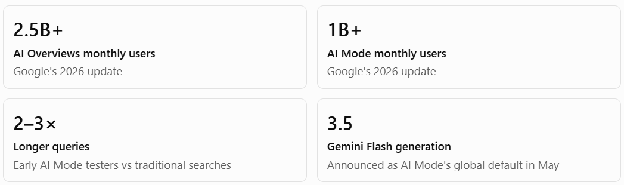
These figures show why AI search deserves attention, but they do not mean conventional Google Search has become irrelevant. Google's AI features continue to draw on its established Search infrastructure and ranking systems.
What Are Google AI Models?
Google AI models are artificial intelligence systems developed to understand and generate information, reason through problems, analyze different media and complete tasks.
The best-known family is Gemini, Google's multimodal AI model family.
Multimodal means these models can work with different kinds of information, including text, images, audio and other supported inputs, depending on the model and product.
However, it is important to distinguish three things:
- Gemini models: The underlying AI technology.
- Gemini app: Google's conversational AI assistant.
- AI Overviews and AI Mode: AI-powered experiences inside Google Search.
This is similar to the distinction between an engine and the products that use it. The same model family can power different applications, but those applications may retrieve information differently and present different results.
Gemini vs AI Overviews vs AI Mode: What's the Difference?
| Feature | Gemini app | AI Overviews | AI Mode |
|---|---|---|---|
| What it is | Conversational AI assistant | AI-generated summaries in Search | Conversational AI Search experience |
| Main purpose | Assistance, creation and research | Quick understanding of a search question | Deeper research and comparisons |
| Where users access it | Gemini app and website | Google Search results | Google Search |
| Follow-up questions | Yes | Available through supported Search experiences | Core feature |
| Web information | Depends on tools and grounding | Integrated with Google Search | Integrated with Google Search |
| Product discovery | Conversational recommendations | Relevant summaries and links | Detailed comparisons and shopping research |
| Best example | Analyze several product specifications | What is a waterproof rating? | Compare waterproof jackets for a specific trip |
| Ecommerce opportunity | Brand and product consideration | Informational discovery | Comparison and purchase research |
The most important distinction is not which experience has the most powerful model.
It is what the customer is trying to accomplish.
Someone seeking a short explanation may interact with an AI Overview. Someone comparing five products against a detailed set of requirements may prefer AI Mode. Another customer might use Gemini to analyze a document, image or shopping shortlist.
How the three experiences fit together
Conceptual illustration. Not a diagram of Google's internal architecture.
Which Google Gemini Models Are Available in 2026?
Gemini is a family of models rather than one fixed system. Google offers different models for reasoning, fast responses, multimodal tasks and specialized applications.
The family has evolved from Gemini 1.5 and 2.0 through Gemini 2.5 and the Gemini 3 generation.
Gemini Pro Models
Pro models are generally positioned for more demanding reasoning, coding, analysis and complex tasks.
They are relevant to businesses because detailed product comparisons can involve multiple constraints, such as compatibility, pricing, materials, warranties and intended use.
However, a model's benchmark performance does not automatically determine whether a particular ecommerce website will be cited.
Gemini Flash Models
Flash models emphasize efficiency and speed while retaining broad AI capabilities.
In May 2026, Google announced Gemini 3.5 Flash as the global default for AI Mode, showing how its search experiences continue to adopt newer models.
Gemini Flash-Lite Models
Flash-Lite variants emphasize efficiency for high-volume applications. They are especially relevant to developers building AI-powered applications that need to process many requests.
Specialized Gemini Models
Google also provides specialized models for applications such as audio, voice and other multimodal tasks.
Developers should consult the official Gemini API model documentation for currently supported models, capabilities and retirement status rather than relying on an older fixed list.
The October 2026 Gemini 4 Update
On October 13, 2026, Reuters reported Google's launch of Gemini 4 Argon, a flagship model for complex tasks, with availability through Google's developer tools and selected paid consumer experiences.
This is a particularly important reminder that model-version comparisons can become outdated quickly.
For ecommerce SEO, the useful lesson is not to optimize for a specific model number. It is to maintain accurate, accessible and useful information that can serve different AI-powered experiences as their underlying models change.
What Is Google AI Overviews?
AI Overviews are AI-generated summaries that appear within Google Search when Google determines that a generated explanation would add value to the search experience.
They can help users understand a question quickly and provide supporting links for further exploration.
For example, a shopper searching:
What is the difference between memory foam and latex mattresses?
might see a summary of the materials, support characteristics and common considerations, together with relevant sources.
AI Overviews are not displayed for every query.
Google decides when they are useful, and the appearance of an AI Overview can vary depending on the search, user and context.
Why AI Overviews Matter for Ecommerce
AI Overviews can influence early product research before shoppers have selected a brand.
A customer researching mattress materials may encounter sources that explain the differences, while someone searching for a specific mattress may see a different combination of search and shopping features.
This creates opportunities for educational articles, category guides and detailed product information.
For example, a mattress retailer could publish a useful guide explaining latex versus memory foam, supported by accurate material information and relevant product links.
The purpose should be to help the shopper make a decision, not merely to insert a brand name into every paragraph.
What Is Google AI Mode?
AI Mode is Google's conversational search experience for more complex questions and extended exploration.
Instead of requiring users to perform several separate searches, it can interpret a detailed request, explore related information and generate an answer with supporting links.
For example:
Compare three ergonomic office chairs under $400 for someone who works eight hours a day, is six feet tall and needs adjustable lumbar support.
That request contains multiple requirements.
AI Mode can help the user explore the options, ask follow-up questions and refine the comparison.
Google describes AI Mode as particularly useful for nuanced questions, research and complex comparisons.
What Is Query Fan-Out?
Query fan-out is a technique that can break a complex question into related searches across subtopics and information sources.
Consider:
What is the best waterproof hiking jacket for winter trekking under $200?
Relevant subtopics could include waterproof performance, insulation, breathability, price, sizing and winter suitability.
Google says both AI Mode and AI Overviews may use query fan-out. The exact searches and sources are determined by Google's systems rather than a fixed publicly disclosed number for every query.
This matters for content strategy because a single vague product description may not answer all the questions involved in a complex purchase decision.
A better approach is to provide clear product specifications, buying guides, comparison information and relevant first-hand evidence.
Why Can the Same Brand Appear in AI Overviews but Not AI Mode?
A brand's visibility can vary across Google's AI experiences for several reasons.
Different User Intent
A short informational query and a detailed shopping comparison are not the same task.
The first may favor explanatory material, while the second may require product specifications, pricing, reviews and comparisons.
Different Retrieval and Response Processes
Google explicitly states that AI Mode and AI Overviews may use different models and techniques, meaning their answers and supporting links can vary.
This does not establish a permanent rule that one experience always prefers high-authority publications while another always prefers forums.
The actual sources depend on the query and Google's systems.
Different Available Information
One answer may include a current product listing, while another may use a category guide or independent review.
This is why product information should remain consistent across relevant webpages, feeds and external sources.
Personalization and Context
Search context, location, language and follow-up questions can change the information a user receives.
For ecommerce brands, regional availability and pricing are especially important. A product suitable for a shopper in the United States may not be available to someone shopping in India.
Answer Variability
AI-generated answers can change between tests, even when prompts appear similar.
Therefore, testing one question once is not enough to determine whether a brand has strong AI visibility.
What Does Google AI Search Mean for Ecommerce Brands?
The commercial opportunity goes beyond being mentioned in an AI-generated answer.
Google's AI experiences can help shoppers compare products, understand specifications and explore purchase options.
For Shopify and other ecommerce businesses, several information sources deserve particular attention.
Product Pages
A product page should clearly explain the product's type, attributes, price, availability, intended use and important limitations.
For example, a shoe description stating only “premium comfort” is less useful for a detailed shopping question than one specifying available widths, cushioning, terrain suitability and sizing.
See Comergent's Shopify Product Data Quality Guide.
Product Feeds and Merchant Center
Google's shopping experiences can use commerce information alongside broader Search systems.
Keep product titles, identifiers, attributes, images, prices and availability accurate.
Google specifically recommends keeping Merchant Center information up to date as part of its guidance for AI features in Search.
Read Product Feed Optimization for AI Search.
Category Pages
Category pages should help users choose among products rather than contain only a product grid and a generic introductory paragraph.
A useful category page can explain available types, features, price differences and selection criteria.
Independent Evidence
Genuine reviews, product testing and credible external coverage can provide additional context for shoppers.
However, businesses should not assume that a specific number of backlinks or Reddit mentions guarantees inclusion in AI Mode.
Product Images
High-quality product images and useful visual context matter for shoppers, especially when product discovery involves visual search.
Google recommends supporting textual information with relevant images and videos.
How to Improve Visibility Across Gemini, AI Overviews and AI Mode
Google's official guidance is clear: existing SEO fundamentals remain relevant, and there are no additional technical requirements or special schema types needed to appear in AI Overviews or AI Mode.
For ecommerce brands, this translates into a practical improvement process.
| Priority | Recommended action | Why it matters |
|---|---|---|
| 1 | Ensure important pages are crawlable and indexable | Supports Google Search eligibility |
| 2 | Improve product descriptions and attributes | Clarifies relevance to detailed queries |
| 3 | Keep Merchant Center data accurate | Supports reliable commerce information |
| 4 | Strengthen category and comparison content | Helps users evaluate options |
| 5 | Use appropriate structured data | Clarifies product and business information |
| 6 | Publish original, useful evidence | Adds information beyond generic summaries |
| 7 | Improve internal linking | Makes relevant pages easier to discover |
| 8 | Maintain genuine reviews and external coverage | Gives shoppers independent context |
| 9 | Monitor relevant AI search prompts | Reveals visibility and information gaps |
| 10 | Measure traffic and conversions | Connects visibility with business outcomes |
Create Content Around Complete Customer Questions
A traditional keyword might be: waterproof hiking jacket
A more detailed AI search might be: Best lightweight waterproof hiking jacket under $200 for winter trekking in India.
The second question includes budget, weight, weather, activity and geography.
Your content should address those needs when they are relevant to your products.
Avoid creating dozens of near-identical pages for every possible prompt variation. Instead, build useful category guides, product comparisons and buying resources that cover meaningful differences.
Add Original Product Evidence
Where possible, include original measurements, testing results, demonstrations and first-hand experience.
A comparison of two office chairs becomes more useful when it includes actual seat dimensions, adjustment ranges, material details and documented testing methods.
Google's May 2026 guidance emphasizes unique, non-commodity content rather than special GEO techniques.
Keep Information Consistent
Check that product information agrees across the website, structured data, Merchant Center and other channels you control.
This is especially important for prices, availability and product variants.
For Shopify brands, Comergent's metafield optimization guide provides a relevant starting point.
How to Measure Google AI Search Visibility
Google AI visibility should not be reduced to a single universal ranking.
A business may appear as a cited source, a brand mention, a product recommendation or a shopping option.
Track these outcomes separately.
| Metric | What to measure |
|---|---|
| AI Overviews visibility | Appearance across a defined set of queries |
| AI Mode visibility | Mentions and citations in complex search tasks |
| Gemini visibility | Brand or product mentions in relevant assistant responses |
| Citation frequency | How often your pages are linked |
| Product visibility | Which products appear in recommendations |
| Competitor visibility | Which competitors appear for the same prompts |
| Answer accuracy | Whether prices, features and claims are correct |
| AI referral traffic | Identifiable visits from AI experiences |
| Conversion performance | Orders and revenue from measurable referrals |
When evaluating visibility, keep the test conditions as consistent as possible.
Record the prompt, date, market, device, relevant context, answer and cited sources.
Do not treat a single generated response as a stable search ranking.
Google Search Console and analytics data should also be interpreted carefully. Google Search's AI features do not necessarily provide a clean, separate attribution channel for every AI-assisted discovery journey.
For a broader monitoring process, read How to Track AI Search Visibility.
A Practical Example: Why One Ecommerce Brand Gets Recommended
Imagine two Shopify stores selling ergonomic office chairs.
Both sell chairs at similar prices, but their product information differs.
| Information | Store A | Store B |
|---|---|---|
| Product description | Generic marketing copy | Detailed specifications |
| Lumbar support | Not clearly described | Adjustment range documented |
| Height suitability | Missing | Explicit |
| Seat dimensions | Missing | Available |
| Product images | Two generic images | Multiple useful angles |
| Buying guide | None | Ergonomic chair selection guide |
| Customer reviews | Limited detail | Genuine, descriptive reviews |
| Product feed | Incomplete | Current and detailed |
For a shopper asking about an office chair for a six-foot-tall person with lower-back support needs, Store B provides more directly usable information.
That does not guarantee Google will recommend Store B.
It does demonstrate why better product information is a sensible optimization priority regardless of the AI model involved.
How Comergent Turns Google AI Answers Into Shopify Orders
For ecommerce teams, the difficult part is not identifying that Google has multiple AI experiences.
It is understanding where products appear, which competitors receive attention, whether brand information is accurate and what improvements could make the catalog more useful.
Comergent AI connects this work to revenue. When a buyer asks Gemini, ChatGPT or Perplexity what to buy and your store is the answer, the resulting Shopify order is tagged with the assistant that sent it.
A practical monitoring workflow should answer four questions:
Where are we appearing? Identify relevant brand and product mentions across supported AI experiences.
Where are competitors appearing instead? Compare visibility for the same buyer prompts.
What information is missing or inaccurate? Investigate product attributes, content, availability and external information.
Is visibility generating business value? Examine identifiable referrals, product-page activity and commercial outcomes.
No tool can promise that a model will recommend a specific product. What you can control is whether your catalog gives Google's AI experiences accurate, complete facts to work with.
Google is already moving toward this next phase: AI agents that shop on the buyer's behalf and complete the purchase with no human click. Comergent's Agentic Feed structures your catalog so those agents can find and evaluate your products, and MCP, ACP, and UCP protocol support lets them buy from your store directly.
Conclusion
Google's AI ecosystem is no longer defined by one model or one search interface.
Gemini models provide the underlying AI capabilities. The Gemini app supports conversational assistance, AI Overviews help users understand questions within Google Search, and AI Mode supports deeper research and comparisons.
These experiences can surface different information because their tasks, context, retrieval processes and model configurations differ.
For ecommerce brands, the most durable strategy is not to chase individual model versions.
It is to build a website and product catalog that provides accurate information, answers real buying questions, demonstrates relevant expertise and remains accessible to Google's Search systems.
Strong SEO, complete product data, useful content and consistent measurement are the foundation of sustainable Google AI visibility.
Sources
Primary sources referenced in this guide:
- Google Search Central: AI Features and Your Website
- Google's Guide to Optimizing for Generative AI Features
- Google: AI Mode and AI Overviews Updates, January 2026
- Google I/O 2026: AI Search Updates
- Google: New Opportunities, Controls and Insights for Website Owners
- Google Gemini API: Model Documentation
Ready to start?
See which ChatGPT queries your competitors rank on.
Install free on Shopify. See your first AI-attributed order within 30 days.
Install on Shopify, Free TrialWritten by
Praneet Chandra, CEO & Co-founder
14+ years of experience working in AI, Cloud, and Retail domains.
Frequently Asked Questions
Related Posts
Deep Research in ChatGPT: How It Works and How to Use It in 2026
Deep Research turns a question that spans dozens of sources into a cited report. Here's how to brief it, check its sources, and use it for competitor, product and market research.
PlatformChatGPT vs Claude vs Perplexity vs Gemini: Which AI Assistant Should You Use in 2026?
ChatGPT reaches 1 billion people a week, but reach isn't answer quality. How ChatGPT, Claude, Perplexity and Gemini compare for writing, research, coding and ecommerce work.