Product Knowledge Graph
A product knowledge graph is a structured network of products, attributes, categories, brands, and relationships that helps AI systems understand how items in an ecommerce catalog are connected.
A product knowledge graph is a structured network of products, attributes, categories, brands, and relationships that helps AI systems understand how items in an ecommerce catalog are connected.
Instead of treating every product as an isolated listing, a product knowledge graph connects relevant information such as materials, compatibility, intended use, variants, and product categories.
For Shopify merchants, this can help AI-powered shopping systems interpret product catalogs and identify items that match specific customer requirements.
What Is a Product Knowledge Graph?
A product knowledge graph organizes product information into connected entities and relationships.
For example, a Shopify store selling running shoes may have products with different sizes, materials, cushioning levels, running surfaces, and intended uses.
A traditional catalog stores much of this information in separate product fields. A knowledge graph makes the relationships between these details explicit.
This approach builds on the broader concept of a Knowledge Graph, which represents entities and their connections in a structured format.
How Does a Product Knowledge Graph Work?
A product knowledge graph typically contains three core components:
- Entities: Products, brands, categories, materials, and other identifiable objects.
- Attributes: Characteristics such as size, color, price, material, and compatibility.
- Relationships: Connections showing how products relate to categories, features, other products, or customer needs.
These components can be represented as connected statements.
For example:
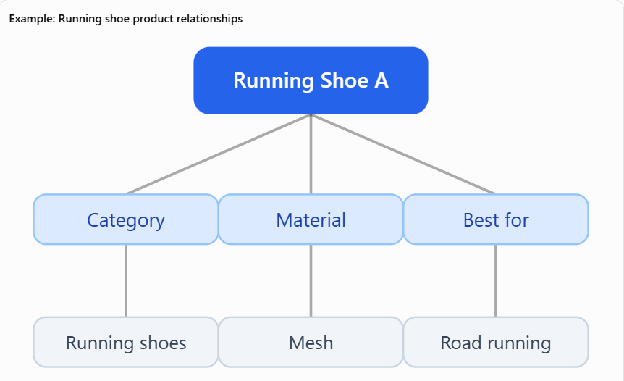
Illustrative graph showing how a single product connects to its category, material, and intended use.
When a shopper asks for lightweight road-running shoes, a shopping system using this graph can identify products connected to those requirements.
Product Knowledge Graph vs Product Database
| Product Database | Product Knowledge Graph |
|---|---|
| Stores product information in records | Represents products as connected entities |
| Focuses on individual fields | Focuses on attributes and relationships |
| Often relies on predefined queries | Supports relationship-based queries |
| Organizes products by records and categories | Connects products, features, uses, and related entities |
| Useful for inventory and catalog management | Useful for semantic discovery and product matching |
A product knowledge graph does not replace a product database. It can work alongside existing ecommerce systems to make product relationships easier to query and interpret.
Why Product Knowledge Graphs Matter for AI Commerce
AI shopping assistants increasingly receive detailed customer requests rather than simple product keywords.
For example:
“Find a lightweight waterproof hiking jacket under $150 suitable for cold weather.”
A system needs to understand multiple requirements, including product type, material properties, weather suitability, and budget.
A well-structured product knowledge graph can help connect these requirements to relevant products.
This supports more precise product discovery, comparison, and Agentic Commerce workflows.
However, a knowledge graph alone does not guarantee that an assistant like ChatGPT will retrieve or recommend a product.
Why Product Knowledge Graphs Matter for Shopify Brands
Shopify merchants often manage catalogs containing hundreds or thousands of products, variants, collections, and custom attributes.
Connecting this information can provide several benefits:
- Better product discovery: Match products with specific shopping requirements.
- Improved catalog consistency: Connect products to standardized categories and attributes.
- More relevant recommendations: Identify related or compatible products.
- Clearer product comparisons: Make specifications and differences easier to evaluate.
- AI commerce readiness: Provide structured relationships that compatible AI shopping systems can use.
Shopify merchants can strengthen this foundation through accurate product information and Product Data Enrichment.
How to Build a Product Knowledge Graph for Ecommerce
Building a product knowledge graph generally involves five steps.
- Collect product data: Gather titles, descriptions, categories, variants, specifications, and brand information.
- Define product entities: Identify products, collections, materials, use cases, and other important concepts.
- Create relationships: Connect products to categories, attributes, compatible accessories, and related items.
- Standardize information: Resolve inconsistent names, duplicate attributes, and missing details.
- Maintain accuracy: Update relationships when products, specifications, or catalog information change.
For Shopify stores, accurate product data is the foundation. Graph relationships are only useful when the underlying information is reliable.
Product Knowledge Graph and AI Search
A product knowledge graph can support AI search by helping retrieval systems identify products through their meaning and relationships rather than exact keyword matches alone.
For example, a customer searching for a “travel-friendly laptop bag” may be interested in products categorized as backpacks, messenger bags, or briefcases.
A knowledge graph can connect those categories through shared attributes such as laptop compatibility, portability, and travel use.
These relationships can support more relevant retrieval, particularly when combined with structured catalog data and semantic search technologies.
How Comergent Helps Shopify Brands Prepare for AI Commerce
Comergent helps Shopify brands improve product visibility across ChatGPT, Claude, Perplexity, Gemini, and Copilot.
For merchants, the priority is making product information clear, accessible, and useful for AI-assisted discovery.
Comergent's Agentic Feed is relevant to preparing structured commerce information for AI-powered shopping experiences.
While a product knowledge graph represents relationships within a catalog, AI-ready product feeds help make product information available to compatible external systems.
Together, structured product information and clear product relationships can support more reliable AI-assisted shopping experiences.